Eighty-day wager deadline
Around the World in Eighty DaysThe Eighty-day wager deadline converts Phileas Fogg’s confidence in timetables into a binding test: he must complete his circuit of the world within eighty days, or lose the £20,000 he risks. Its force comes from the collision between an apparently exact calendar limit and a journey repeatedly exposed to unfinished routes, missed connections, and human interference. The final reversal depends on a fact the deadline’s arithmetic initially obscures: traveling east has given Fogg an extra day.
The stipulated interval
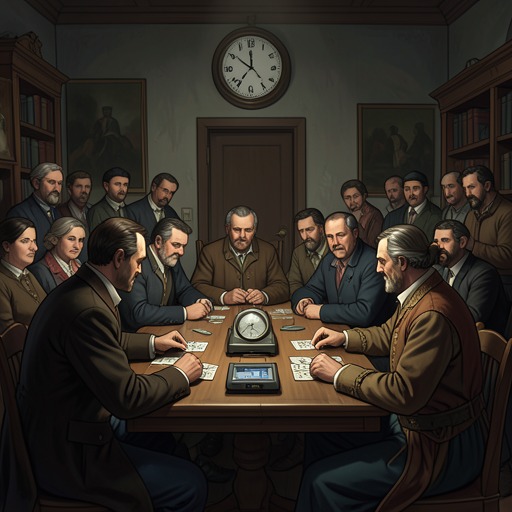
The wager is made on 2 October, amid discussion at the Reform Club about whether the journey can actually be completed in eighty days. The objections name the contingencies that a timetable cannot guarantee: bad weather, contrary winds, shipwrecks, railway accidents, and deliberate interference with the tracks. Fogg accepts that these are included in the challenge rather than treated as exceptions. He stakes £20,000 held at Barings Bank, making the limit both a test of his judgment and a substantial financial risk.
Fogg’s answer to uncertainty is to treat the journey’s shortest calculated duration as sufficient. He insists that the unforeseen does not exist and accepts that transfers from trains to steamers, and back again, must be made with mathematical precision. The wager’s terms therefore reward not simply reaching a destination, but arriving before a fixed moment; every delay threatens the whole sum.
Precision against the journey
The story sets Fogg’s strict approach to time against the imperfect instruments and systems on which travel depends. At home, he dismisses James Forster because the shaving water is eighty-four rather than eighty-six degrees Fahrenheit, and follows a complicated clock that records seconds as well as dates. Yet Passepartout’s family watch is two hours slow: when Fogg urges him not to miss the steamer, the watch tells him it is only eight minutes before ten, though the time given to him is twelve. Personal discipline cannot make every clock agree.
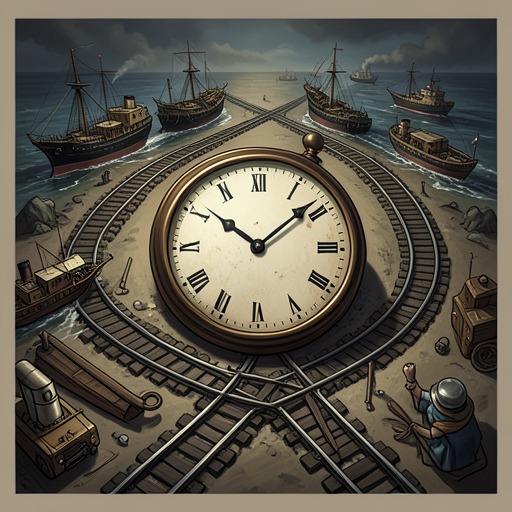
The route is no more seamless than its timekeeping. At Kholby, the party learns that the railway is unfinished, with fifty miles still to be laid before Allahabad. The gap makes literal the distance between the timetable’s clean sequence and travel on the ground. Later, after the interruption by the Sioux, Fogg is told that he is twenty hours behind and must regain eight hours; a sail sledge offers a way to recover part of the lost time.
Even after reaching Omaha, the party has no margin for sightseeing. The Pacific Railroad ends there, and the onward connection runs east toward Chicago on the Chicago and Rock Island Railroad, passing fifty stations. A train is ready when they reach the station, and they only have time to board. These hurried transfers show what Fogg’s promise of mathematical jumps demands in practice: continuous movement through systems whose connections can fail or arrive just in time.
Delays and changing plans
The agreed interval has to absorb more than railway gaps. Fix resolves to tell Passepartout the truth about his purpose because he wants Fogg detained in Hong Kong. Elsewhere, Fogg searches the docks for a vessel that can carry him toward Yokohama; after three hours without finding a suitable departure, he continues looking rather than abandon the attempt. Such episodes make the deadline vulnerable not only to weather and transport, but also to decisions by people pursuing their own aims.
Near the end, the remaining time can be stated with startling exactness. On 12 December, the interval from seven in the morning until a quarter before nine on the evening of 21 December is nine days, thirteen hours, and forty-five minutes. Had Fogg sailed in the China, he could have reached Liverpool and then London within the agreed period. The Henrietta passage is less secure: the crossing may fit into the remaining nine days, but only if the sea stays manageable, the wind does not turn east, and neither vessel nor machinery suffers an accident. The deadline remains fixed while the means of meeting it become increasingly improvised.
The gained day and the result
Fogg appears to have lost the wager because he mistakes the date on his return. In fact, he has completed the circuit in eighty days and arrives at the Reform Club at a quarter before nine. The apparent error is a consequence of traveling continuously eastward: as he moves toward the sun, local days diminish, and the accumulated difference over the earth’s 360 degrees amounts to twenty-four hours. Fogg has seen the sun pass the meridian eighty times while his friends in London have seen it pass only seventy-nine.
That uncounted day turns a journey that seemed late into one completed within the limit. Fogg wins the £20,000 wager, not because the route proved free of accidents, but because the deadline’s calendar calculation did not account for the effect of circling the globe eastward. The rule that first appears to measure his failure thus supplies the condition of his success.